Native Instruments Guitar Rig Presets

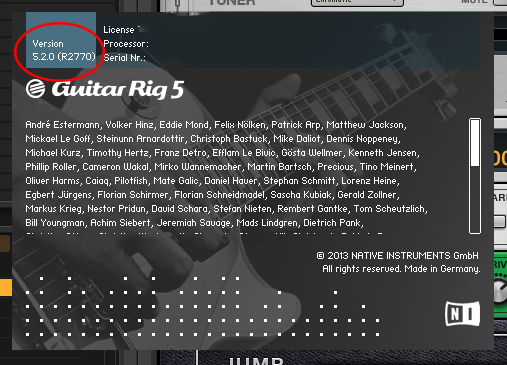
A studio full of amps, cabs, mics and creative tools – GUITAR RIG gives you the power to shape your tone to perfection. GUITAR RIG User Library Download GUITAR RIG presets. © 2018 Native Instruments GmbH Legal. The NI User Libraries are comprehensive. If no presets are present in the GUITAR RIG browser. My GUITAR RIG 5 Browser Does Not Contain Any. Delete the file 'com.native-instruments.Guitar Rig 5.plist'. The market for software that emulates guitar amplifiers is pretty crowded these days, but Native Instruments have found a new angle with a modular program that comes.
Native Instruments have repackaged their powerhouse amp-modelling package with a new, stage-friendly interface, not to mention four new amps and a pile of vintage effects. Guitar Rig 3’s new streamlined interface incorporates a redesigned preset browser with Kore compatibility. This shot also shows off the new Space Echo and Orange amp emulations.What makes a good software amp simulator? For some guitarists, there’s only one answer: a good amp simulator is one that sounds, and responds, exactly like the amps it simulates. Download Counter Strike Source Password Rar.
To others, the real joy of a software amp is that it allows them to do things that are impossible with hardware, whether that means automating knob movements in real time, routing three different amps in series, or putting a glockenspiel through a Marshall stack. Native Instruments’ Guitar Rig is an obvious choice for anyone in the second camp. Its unique modular design makes it easy to construct bizarre and electrically unsound combinations of virtual gear from the safety of your laptop. Version 2, reviewed in February 2006 (), upped the ante with the rather wonderful Modifiers, which brought the concept of synth-style modulation to bear on amp and effect parameters, with unparalleled scope for weirdness. Time moves on, and NI have now brought out Guitar Rig 3.
This brings with it a welcome crop of new amp and effect modules, but in contrast to the previous upgrade, most of the other improvements are directed at making Guitar Rig more friendly to use, rather than opening up new possibilities for experimentation. There’s a particular focus on making the system more useable on stage as well as in the studio. Central to both applications is the Rig Kontrol hardware unit, which combines the roles of DI box, audio interface and foot controller, and has also been improved in version 3. The most obvious changes are that it is now a rather stylish black instead of silver, and that it sports eight buttons instead of six. The floorboard itself hasn’t grown, so you’ll need to be a little more delicate with your size nines, but it shouldn’t cause problems except for the most cack-footed. The top row of buttons are now clearly labelled according to their default functions, so you’ll never have those moments on stage where you forget which button brings up the tuner. Other welcome additions include LED input and output level meters.
A more subtle but potentially life-saving improvement is the relocation of the USB port to the rear left, where it has been augmented by a chunky hook to secure the cable. It’s still, probably, better to not get your foot caught up in it, but this might just be enough to stop you having to reboot the computer on stage. Internally, the Rig Kontrol seems little changed. NI say that the converters have been improved, and it certainly sounds very clean, but then so did its predecessor, to my ears.
The Rig Kontrol still connects to your computer via a USB2 port, and the driver has been tweaked to provide more informative options for buffer sizes. It seemed happier to run at low latencies in my system than the Rig Kontrol 2, and I experienced none of the occasional clicking that I found with the previous version. In general, I imagine most Rig Kontrol 2 owners will be content to stick with their existing hardware, though. The Guitar Rig 3 software is available independently of the Rig Kontrol, and will still work with previous hardware versions. Like all NI software, it needs to be authorised on-line, but the process is painless. Unless you don’t have an Internet connection on your studio computer, that is, in which case it could cause a mild twinge.
As before, Guitar Rig 3 works both as a stand-alone application and as a plug-in in VST, Audio Units and RTAS formats. The first thing you notice on loading the new version is the new look, which struck me as an obvious improvement: the interface is now much cleaner and easier to navigate, and it features a greatly improved preset–handling system (see the ‘Preset Paradise’ box). Live View presents all the parameters that are accessible from the Rig Kontrol in such a way as to make them easily visible at a glance.